
In this guide 8 sections
Start with the finished edge drawing
Choose a profiling wheel by the required edge geometry, tile material and thickness, machine interface and finishing sequence. Specify the radius and complete section drawing before selecting diameter or bond. A wheel that fits the spindle still needs the correct working profile and an approved process for the required surface.
A square edge, a bevel and a radius are different profiles
01Squaring
Establishes a straight edge and its relationship to the tile faces.
02Chamfering
Creates an angled face. Specify angle and the required remaining edge.
03Profiling
Creates a curve. Specify radius, tile thickness and the complete edge drawing.
Distinguish the operation you need
Squaring establishes size and a straight edge. Chamfering creates an angled face. Profiling creates a curve or another defined contour. A photograph can communicate appearance, but a section drawing should define the dimensions the tool must produce.
Montolit’s profiling-system information separates bevel, miter and radius tooling by working geometry. Use the specifications and instructions for the actual tool system you intend to buy.
For ceramic tile, identify the body, glaze, thickness and any backing. State which part of the edge will remain visible and whether polishing or another process follows. A tool that makes the required curve may still leave a surface that needs a later finishing stage.
Compare the available diameter and radius options
| Product family | Diameter options | Segment height × thickness | Radius options |
|---|---|---|---|
| Metal-bond profiling wheels | 98 / 110 / 125 / 150 / 200 / 250 mm | 10 × 6 mm | R10 / R12 / R14 / R16 / R18 |
| Resin-bond profiling wheels | 98 / 110 / 125 / 150 / 200 mm | 10 × 6 mm | R10 / R12 / R14 / R16 / R18 |
Compare the options Tap to expand
Metal-bond profiling wheels
- Diameter options
- 98 / 110 / 125 / 150 / 200 / 250 mm
- Segment height × thickness
- 10 × 6 mm
- Radius options
- R10 / R12 / R14 / R16 / R18
Resin-bond profiling wheels
- Diameter options
- 98 / 110 / 125 / 150 / 200 mm
- Segment height × thickness
- 10 × 6 mm
- Radius options
- R10 / R12 / R14 / R16 / R18
These dimensions identify available options in the profiling family. Confirm the complete configuration, mounting and working position for your machine and drawing. A radius designation alone does not describe the entire finished edge.
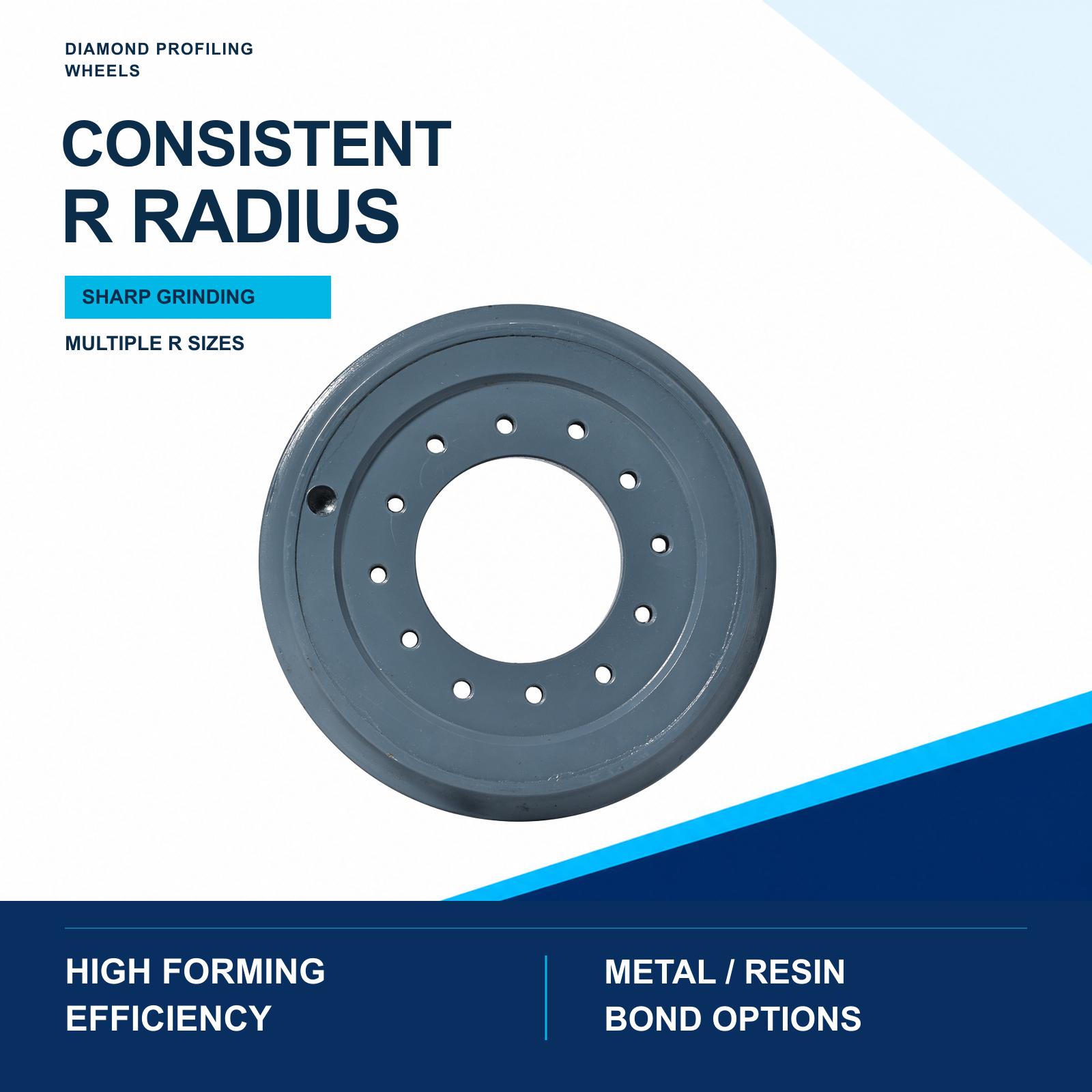
Diamond Profiling Wheels
Send the required R profile and a section drawing with the tile thickness. Match metal-bond or resin-bond options to rough shaping or fine rounding, then confirm the diameter and mounting interface.
View specificationsPlan forming and finishing together
A rough stage removes the initial allowance. Intermediate and fine stages refine the surface while preserving the intended geometry. The exact number of stages depends on the machine, material, incoming shape and final requirement.
Use the finished drawing as the reference
- 01
Define the curve
Provide a section drawing with radius, thickness and final dimensions.
- 02
Allocate the removal
Separate rough forming from intermediate and fine processing where the system requires them.
- 03
Check the machine
Confirm the mounting, working position, speed and wet/dry mode.
- 04
Inspect the complete edge
Compare geometry and finish after the full sequence, including the first and last parts of the pass.
Check the edge after each stage when developing a setup. If a flat remains on the curve, inspect the profile and tool position before increasing pressure. If deep marks persist at the end, find which stage creates them and whether the following stage has enough suitable allowance to remove them.
Match the wheel to the machine
Confirm mounting dimensions, permitted diameter, speed, working direction and wet/dry mode. Check spindle condition, alignment and support. Use the machine maker’s positioning reference when installing a replacement so the new wheel is compared from the same starting point.
For grinding silica-containing material, use the site’s specified exposure controls and follow the equipment and material instructions. Keep coolant delivery and dust-control arrangements with the process record.
Selection example: specifying a rounded edge
Suppose the drawing calls for an R12 edge on a ceramic tile. Start with that drawing and the actual tile thickness; do not select only by a wheel marked R12. Confirm the tool’s complete shape, working position, mounting and allowance for the subsequent finishing steps.
Inspect the first completed edge against the drawing. Check the curve, any remaining flat, visible-face chipping and final finish. Keep the approved setup and sample so a repeat order has a clear reference.
What to send for a profiling-wheel quotation
Send the section drawing, material and thickness, machine model, current wheel dimensions and the intended finishing sequence. Include a photograph of the existing edge if it has a defect. Ask the supplier to identify the proposed profile and configuration on the quotation so it can be checked at delivery.
FAQ
What is the most important profiling-wheel specification?
The finished profile geometry and machine interface are the starting points. Bond and grit must then be matched to the material and process stage.
Can one profiling wheel create and finish the complete edge?
A single-stage process may be possible, but heavy forming and fine finishing often place conflicting demands on one wheel. A staged process may provide better control.
How do I specify a radius profiling wheel?
Provide the radius, tile thickness, profile depth, reference surface and a dimensioned drawing. A radius label alone may not define the complete geometry.
Can a diamond profiling wheel be customized?
Depending on the project, customization can include dimensions, specification, formulation and profile requirements. The machine and approved drawing must be confirmed before production.